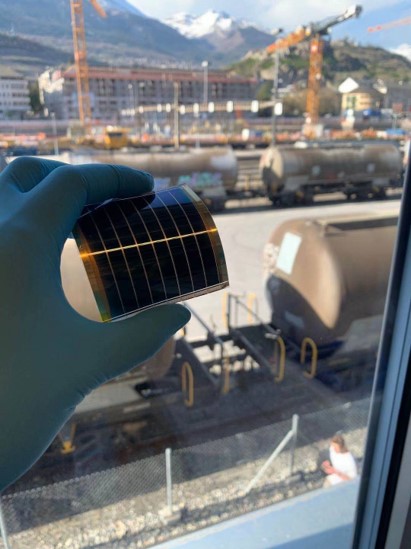
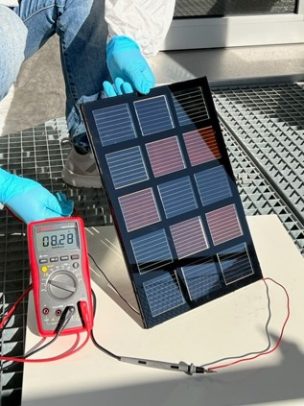
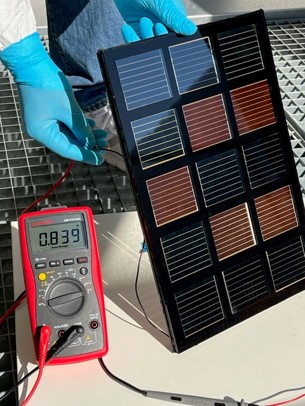
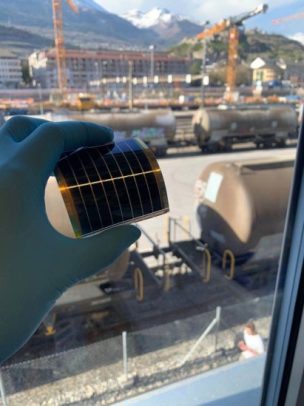
Our perovskite solar cells are made using a scalable manufacturing methodology and materials set that can be tuned to cover a range of applications. We have demonstrated the feasibility of producing small (6.5 X 7 cm2) monolithically series interconnected modules (8 subcells) that yielded a stabilized power conversion efficiency of over 23%. Our product offers a lower production cost than traditional silicon solar cells, while also providing a higher energy yield.
Prototype Product 1: 6.5 X 7 cm2 Mini-modules
Prototype Product 2: 30 x 30 cm2 Modules
Prototype Product 3: 100 X 120 cm2 Modules
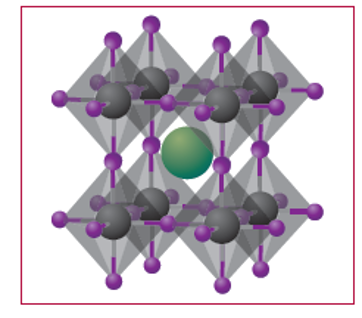
Perovskites Materials
General formula: ABX3
A (green): Cs+ , CH3NH3+ or CH(NH2)2+
B (dark grey): Pb2+, Sn2+ : X (red): Br- , Cl, - I-
Perovskite Properties:
Strong light absorption in the visible region
Tunable band gap and remarkable defect tolerance
Small exciton dissociation energy (<30 meV)
1. High efficiencies beyond that of traditional silicon photovoltaics.
2. Low-cost production as the materials and manufacturing processes are comparably inexpensive.
Flexibility and versatility as the panel can be made in glass or plastic, the latter being 100 times lighter than current commercial silicon photovoltaics.
Rapid production as low-energy solution-based processes are used.
Potential for innovation as the product can be continuously upgraded as superior components are discovered.
Environmental Benefits as they are based earth abundant elements, are inexpensive to fabricate and are fully recyclable.
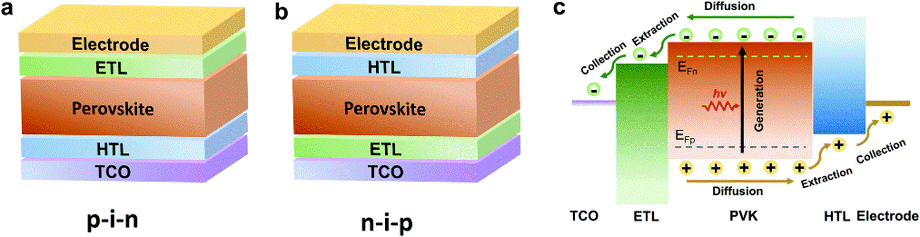
Device structures
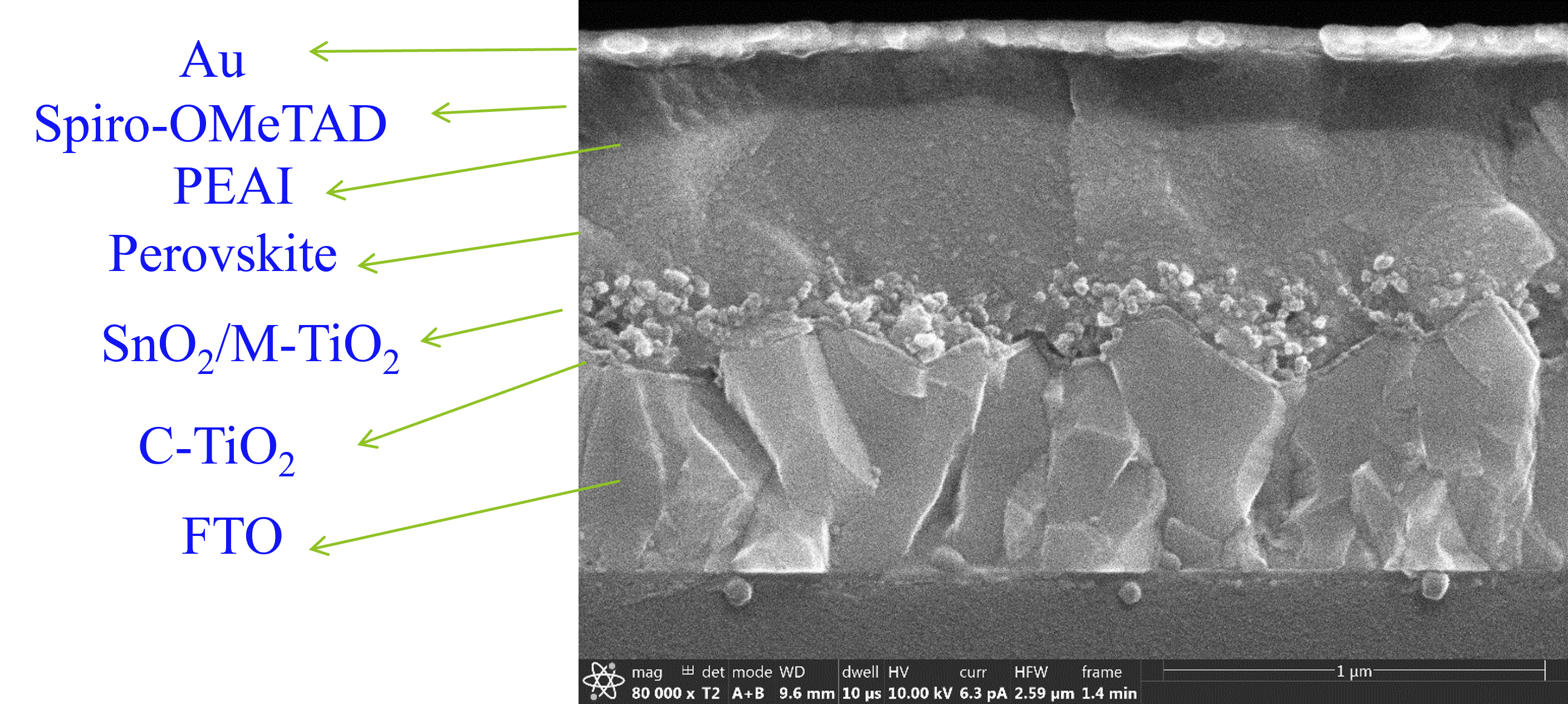
n-i-p device structure diagram: SEM image of cross-section view for the device
Photovoltaic performance of PSCs and perovskite solar modules.a Cross-section SEM image of the fabricated PSC. bJ–V characteristics of the best-performing device. c Photograph of the nine-subcell perovskite solar module.
Device performance Aperture area: 27.22 cm2
New record efficiency
on mini-module 22.50%
Module performance
Power conversion efficiency 23.3%, 6.5 x 7 cm2 PSC module 27 cm2.